


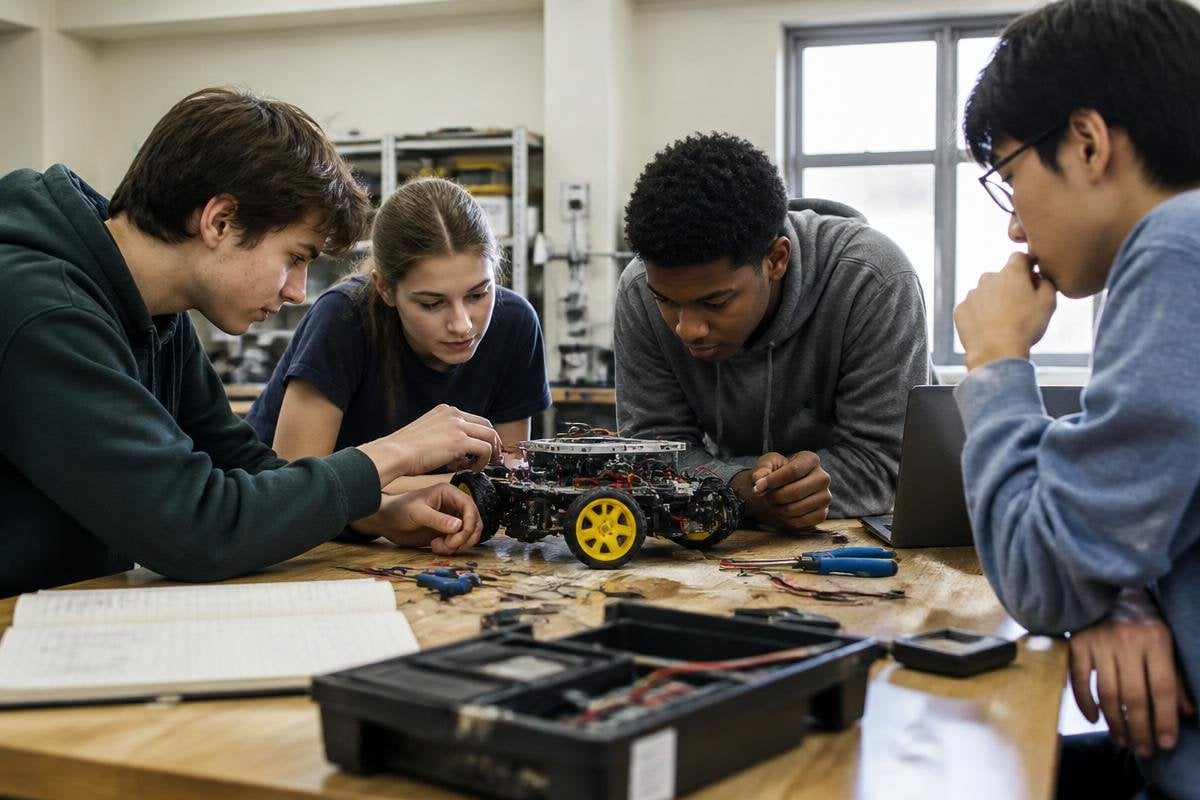
A robotics club turns a table, a small controller, motors, sensors, and a few tools into a working lesson. Members see code move a wheel, then learn why the wheel stopped when the battery sagged or a wire came loose.
Quick read:
- Clubs connect code with physical results.
- Shared tools let more people try robotics before buying a full kit.
- Good clubs teach testing, safety, and repair alongside building.
The work teaches more than code
A robot needs several parts to work together. The controller runs the program, sensors collect information, the motor driver sends power, and the battery supplies that power. Members can see those links one at a time in a club.
That makes each mistake easier to understand. If a line-following robot turns too late, the cause may sit in the sensor position, the program’s threshold, or the motor speed. The fix starts with a test, not a guess.
The same habit applies to larger autonomous systems. A member who learns to record sensor readings and change one setting at a time has a useful way to handle a mobile robot, a robotic arm, or a vision system later.
Failure becomes visible
Robotics has a useful quality: weak ideas fail in front of you. A gripper misses a block. A wheel slips on a smooth floor. A program sends the robot past its marked stop point.
Those results give the group a clear next task. Check the grip. Measure the wheel speed. Change the stopping rule. The work stays tied to something people can see and measure.
Clubs also make repair part of learning. Members can check voltage with a meter, inspect a connector, read an error message, and replace a damaged part. These are small tasks, but they build care around machines that must work safely near people.
Shared equipment changes who can try
A complete robotics setup can include a controller, motors, sensors, a battery, a charger, tools, and software. One person may not have access to all of that. Shared equipment lets members spread the learning across many projects.
That shared setup matters because robotics has a physical side that videos and tutorials cannot replace. Someone must hold the sensor at the right height, route the cable away from a moving joint, and watch the robot respond on the floor.
A club project gains context when members compare it with reports on robotics at Robot24.com. Coverage of working robots and the companies building them can show how a small test fits into work beyond the club room.
Beginners can also find several ways to join. One person may write code. Another may draw the frame, wire the motors, test the battery, or document each change. The project still needs the full group to work.
What a good club needs
The name on the door matters less than the way the club runs. A useful group gives members time to build, test, ask questions, and fix their own work.
Use this checklist when you’re starting or joining one:
- A clear project: Pick a task with a visible result, such as following a line, sorting objects, or mapping a small room.
- Safe power work: Set rules for batteries, chargers, exposed wires, and moving parts before testing begins.
- Shared notes: Record the code version, wiring changes, sensor readings, and the result of each test.
- Small test areas: Mark a floor space where the robot can run without hitting people, furniture, or other equipment.
- Several jobs: Rotate coding, wiring, mechanical work, testing, and documentation so one member doesn’t carry the project.
- A repair budget: Keep common wires, connectors, fasteners, and replacement parts available for the next failure.
These habits also make the club easier to grow. New members can read the notes, repeat a test, and take on one part without starting from a blank page.
The next project should be testable
The best club projects end with a result you can check. Set a route, count successful runs, measure stopping distance, or record how many objects the gripper places correctly. A clear test gives the group a place to start again.
I’d recommend a small project with one moving part before a large robot with many unproven functions. The next useful question is simple: what can the club build, measure, and repair in its first month?
